
How Much Should I Pay Myself From My Business?

By Kendall Maccagnan, CPA, CFP® and Financial Advisor in Tampa, Florida
How much should you pay yourself as a business owner? How much you can sustainably pay yourself depends on your business's cash flow, operating expenses, taxes, cash reserves, and how much you need to reinvest in the business.
Instead of looking at what's sitting in your bank account, I like to think about owner pay as part of a larger cash flow system. Decide what you need the business to pay you, give every dollar coming into the business a job, and test whether the business can consistently support that number. And if it can't? That's when we need to start looking under the hood of the business.
How Much Should I Pay Myself as a Business Owner?
It can be tempting to look at the balance in your business bank account and use that number to decide what you can afford to spend that day or that week. I see business owners do this all the time. If there’s a little extra cash sitting in the account, it can be tempting to take a little extra out, maybe even treat yourself to a nice dinner.
The problem is that your bank balance that day doesn't tell you what's in the pipeline.
Maybe a year ago you paid for an annual subscription because it was cheaper than paying monthly. Now, one year later, you have just completely forgotten about it until... boom.. that autopay hits your account. Or maybe this is one of those months with three payroll cycles instead of two and you just completely forgot.
Those expenses may not be reflected in today’s bank balance, but the cash still needs to be there when they come due.
That's why I think every business owner needs a system for looking ahead and giving their cash a job. You need to know what is available for taxes, operating expenses, upcoming bills, business reserves, reinvestment, and obviously your salary! After all, you are the reason the business exists in the first place.
Give Every Dollar in Your Business a Job
I like to recommend that business owners think about every dollar coming into the business as belonging to a specific bucket.
This idea is similar to the cash-allocation approach in Mike Michalowicz's book Profit First, which sets money aside for profit, owner pay, and taxes before covering operating expenses. Instead of waiting until the end of the month to see what is left, you intentionally decide where your cash needs to go as it comes in.
Every business may have different buckets and different percentage allocations, but the concept is the same: give every dollar a job. When a customer payment comes in, divide that money between its different purposes on paper and between separate bank accounts.
Here is an example of how a hypothetical $1,000 customer payment might be divided:
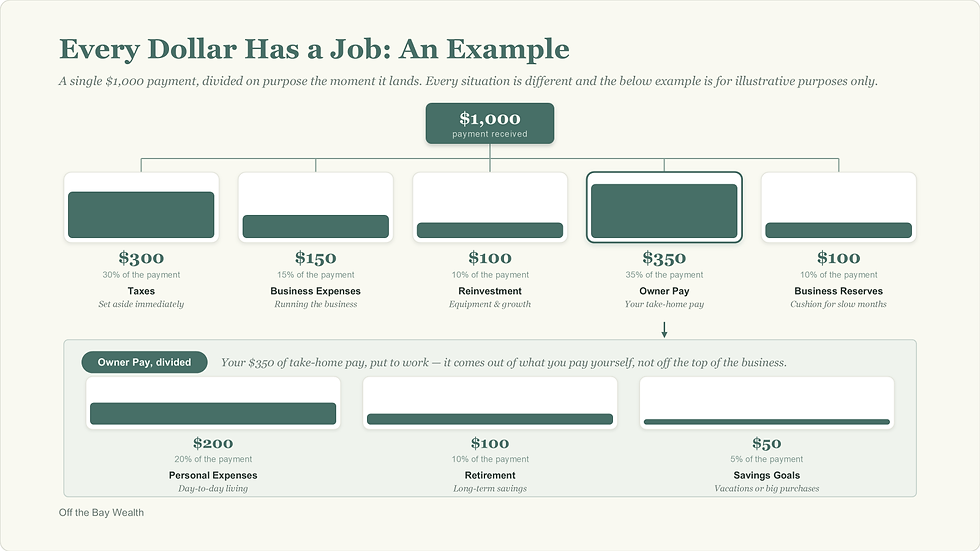
Your buckets/separate bank accounts might include:
Taxes: money set aside for future tax payments.
Business expenses: cash needed to operate the business.
Business reserves: a cushion for slower months or unexpected expenses.
Reinvestment: money intentionally kept for equipment, hiring, marketing, or growth.
Owner pay: money available to support your personal financial life.
These percentages are only an example. Your actual allocations may look very different depending on your business, goals, expenses, and tax situation. The important part is having a system for deciding where each cash deposit needs to go before you spend it.
Should You Pay Yourself First?
Paying yourself first means treating owner pay as a planned part of your cash flow, not whatever happens to be left over. It's the central idea in Profit First: when owner pay and profit are funded up front, the business has to operate on what remains, which creates pressure to run more efficiently.
Mike Michalowicz compares this concept to eating dinner from a smaller plate in his book Profit First. Give yourself a smaller plate, and you naturally have less room for food. In a business, intentionally allocating money to profit and owner compensation leaves less cash available for operating expenses, creating pressure to run the business more efficiently.
I like the discipline this creates, and I pair it with a regular review of expenses. Rather than waiting until cash gets tight to decide which expenses need to go, I prefer to have business owners intentionally review their expenses before there is a cash crunch.
List out what the business is currently spending money on and ask what each expense is actually doing for you. Is it essential to operating the business? Does it generate revenue? Does it save meaningful time? Is it something you still use? Or is it simply an expense that has quietly become part of the monthly credit card bill? This is one of the exercises I like to work through with business owners.
The goal is to make sure every expense competing with your owner pay has earned its place in the business!
Paying yourself first also doesn't mean paying yourself before taxes. As a lifelong accountant, I have to emphasize the one bucket you can't outrun: taxes 😰.
Before deciding how much cash is available for owner pay, I generally want business owners to understand their expected tax obligations and intentionally set aside money for them. The money sitting in your business checking account can feel available today, but part of it may already belong to a future tax payment.
That is why I prefer to think about owner pay as part of a larger cash flow system:
Money comes in → every dollar gets a job → essential business obligations are funded AND you intentionally pay yourself.
So, How Much Can You Actually Afford to Pay Yourself?
Now that every dollar has a job, we can get back to the original question: How much should you pay yourself from your business?
I like to start with a number: what do you need the business to pay you? Then test whether the business can support it.
Start with the cash coming into the business and work through your buckets alongside that number. How much needs to cover operating expenses? How much should be set aside for taxes? Are there upcoming purchases or investments you are planning for? How much does the business need in reserves?
This shows you whether the business can sustainably pay you that amount. And I emphasize sustainably because one really good month doesn't necessarily mean you should immediately go buy a yacht.
But what happens if you work through your buckets and the business honestly can't support what you deserve to be paid for running this big, ugly baby of a business?
Then we have some work to do! After all, one of the goals of being a business owner is to build wealth outside of the business.
This is where I would start looking under the hood. Which products or services are actually generating a healthy profit? Are there expenses that are no longer earning their place in the business? Are you pricing your products or services appropriately? Are your margins where they need to be?
How Much Should You Pay Yourself From Your Business?
The answer to “How much should I pay myself?” usually isn't as simple as changing the amount you transfer to your personal account. If there isn't enough left after working through your necessary expense buckets, it may be time to look deeper at your pricing, margins, expenses, and profitability to understand why.
At the end of the day, your business should support your life, not just continually consume more of your time and cash. The goal is to understand where your money is going, intentionally fund what the business needs, and build a system that allows the business to sustainably pay you along the way.
Next step: If you want help connecting your business cash flow, taxes, and owner pay with your personal financial goals, a financial advisor tailored to business owners may be able to help. Feel free to book a consultation to discuss financial planning for business owners.
Frequently Asked Questions About How Much to Pay Yourself as a Business Owner
How much should I pay myself from my business?
There is no standard percentage or dollar amount that every business owner should pay themselves. Your owner pay may depend on your business's cash flow, operating expenses, taxes, reserves, reinvestment needs, and personal financial needs. A good starting point is deciding what you need the business to pay you, then testing whether its cash flow can sustainably support that amount after setting aside money for taxes and essential expenses. If it can't, that may be a sign to take a closer look at your pricing, margins, and expenses.
What percentage should I pay myself as a business owner?
There is no universal percentage of revenue or profit that a business owner should pay themselves. Two businesses with the same revenue could have completely different expenses, margins, and cash needs. Instead of relying on an arbitrary percentage, consider creating a cash allocation system based on the actual economics of your business.
How much should I pay myself from an LLC?
How you pay yourself from an LLC depends on how the LLC is taxed. If your LLC is taxed as a sole proprietorship or partnership, you generally take owner draws rather than a salary, and you're taxed on the business's profit whether or not you withdraw it. If your LLC elects S corporation tax treatment, owners who work in the business generally need to receive reasonable compensation through payroll before taking distributions. Regardless of tax structure, the amount you pay yourself should work alongside the cash the business needs for taxes, operating expenses, and reserves.
How much should an S Corp owner pay themselves?
If you are an S corporation shareholder-employee who performs services for the business, you generally need to receive reasonable compensation before taking non-wage distributions. There is no universal percentage that determines a reasonable S Corp salary. Factors may include your responsibilities, experience, time spent working in the business, services performed, and compensation for comparable work.
Should I pay myself first as a business owner?
Paying yourself first, a central idea in Mike Michalowicz's book Profit First, can create discipline by making owner compensation an intentional part of your business's cash flow rather than whatever happens to be left over. But paying yourself first doesn't mean paying yourself before taxes. Your owner pay still needs to work alongside money set aside for taxes, essential operating expenses, and cash reserves. The goal is a system that lets you pay yourself consistently while keeping the business financially healthy.
How much money should I keep in my business before paying myself?
There is no single cash reserve amount that works for every business. Consider your essential monthly expenses, how predictable your revenue is, upcoming bills, payroll, taxes, seasonality, and potential unexpected expenses. A business with employees, equipment, or significant fixed costs may need a different cash cushion than a business with very little overhead.
This content is provided for educational and informational purposes only and should not be construed as investment, tax, or legal advice. It is not intended as a solicitation or offer to provide advisory services in any jurisdiction where Off the Bay Wealth, LLC is not properly registered or otherwise permitted to operate. Information presented is based on sources believed to be reliable; however, accuracy and completeness are not guaranteed. This material is not intended to be a comprehensive analysis of all topics discussed. IRS provisions are subject to ongoing guidance and regulatory updates. Any financial decisions should be made in consideration of your individual circumstances, including your goals, risk tolerance, and time horizon. Investing involves risk, including the potential loss of principal.


Comments